
You can sell well beyond the four walls of your restaurant, provided you choose the right channels and start with the right format.
CEO · Belorder
Most brands that want to increase their revenue make the same mistake: they pile on channels (kiosks, apps, delivery platforms) without asking which one is truly growing their profit margin, and which one is merely growing their costs.
The real question isn't «should we digitalise?» it's «Quels canaux de digital order taking, in what order, and at what actual cost?». The right order, to sell more without exploding costs, we increase turnover by acting on three levers for order picking and delivery, and we look at what each one brings in Net, once commissions and fixed costs have been deducted.
Digitising order taking multiplies the ways a customer can order, without multiplying your fixed costs. The three levers:
The aim isn't just to score: it's to Take more orders, faster, with a higher basket value, without adding staff.
+15 to 30 % of medium-sized baskets. The terminal remains the most cost-effective channel to install first.
This is where additional revenue is made – and where you do the most damage if you choose poorly.
Delivery platforms (Uber Eats, Deliveroo) are a great way to Generate a first stream of customers and to test the digital command as a sales channel. But they have two hidden costs: one commission of 30 to 40 % taken from each order, and — often more serious in the long term — they keep the customer data. You sell, but you don't know to whom: you can neither retain nor reactivate.
A website or app for ordering in your own colours (private label) Reverse the logic: the customer orders directly, without platform commission, and The data belongs to you. It's the channel that builds a sustainable asset – a base of re-engageable customers – whereas platforms only build rented volume.
The correct sequence is not «either/or», it's «one then the other»: use platforms to capture an initial flow, then gradually switch these customers over to your direct channels, where the margin and data come back to you.
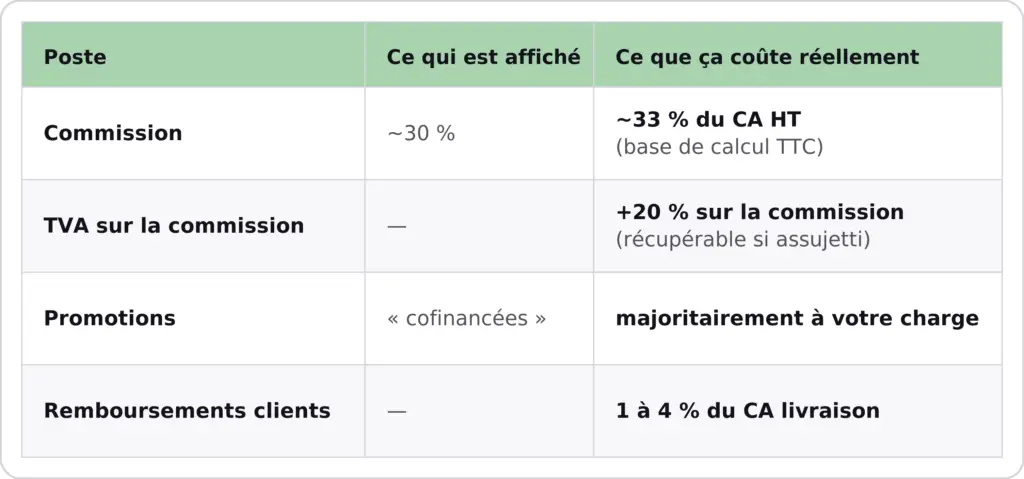
The advertised commission rate — often 30 % at Uber Eats when the platform handles the delivery, and 25 to 32 % at Deliveroo — is only the tip of the iceberg. The actual cost incurred is higher, for three reasons that are rarely explained:
Added to this are the re-invoicing of customer refunds (often 1 to 4 % of delivery turnover), payment and marketing costs, and sometimes activation fees. The result: in a sector where the net margin hovers around 8 to 12 %, as shown The study of Commandici, the effective cost of a marketplace is commonly between 33 and 36 % of turnover on delivery — several points of margin, on a channel where you don't even get the customer data.
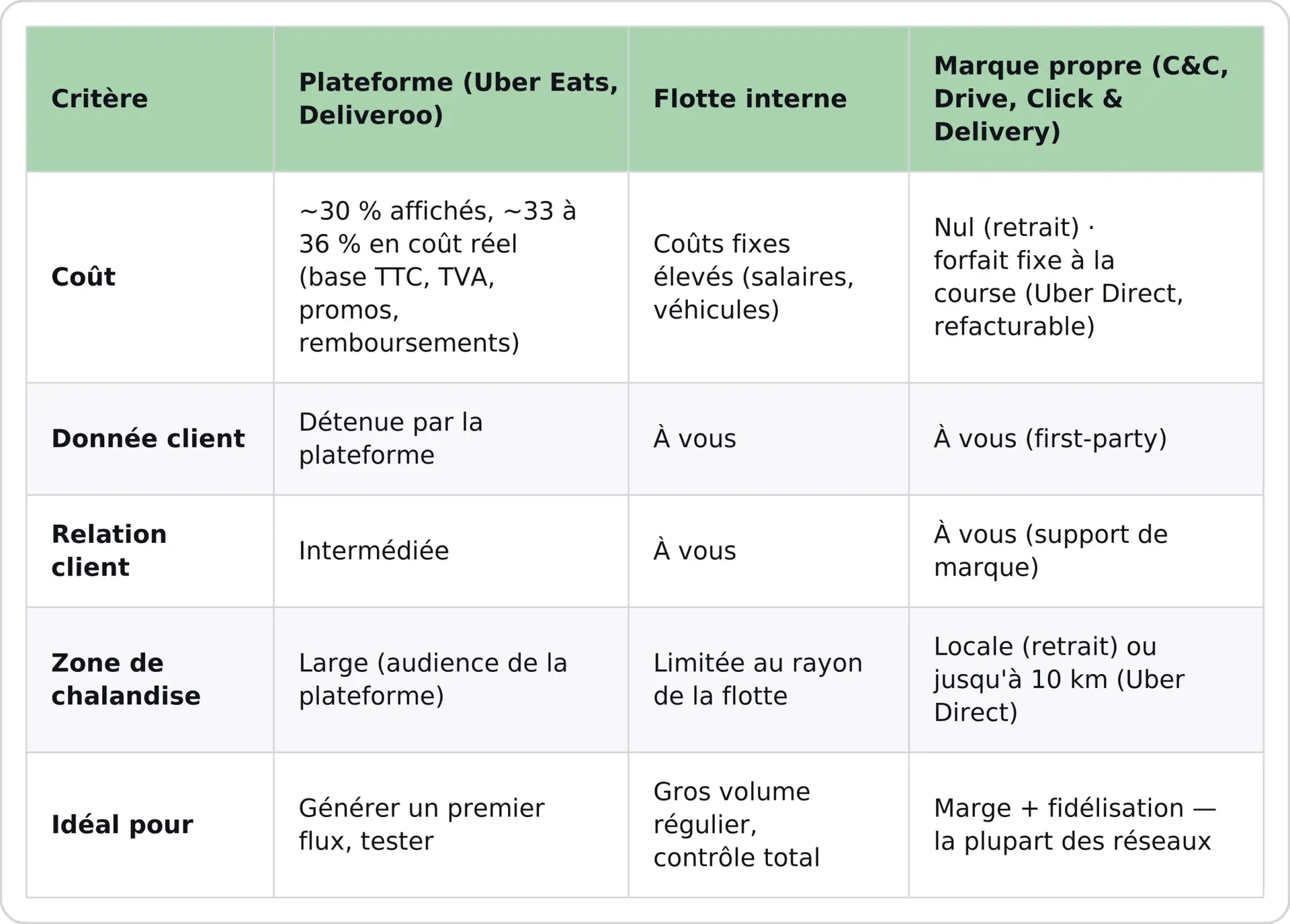
Once the order is taken live, the thorny question remains: How can we give it back to the customer without losing the margin we've just saved? Four options, not to be confused:
The idea is simple: the customer orders on your site or your application, and delivery is provided by the Uber Direct courier fleet — in express (the same day) or on 30-minute scheduled slots. Your brand, your customer relations, your data; their fleet for the last mile.
The difference with a marketplace is economic and strategic:
From a logistical standpoint, the coverage is there: according to Uber Direct, it is France’s largest fleet of couriers (over 65,000 active couriers per week), available in more than 360 towns and cities covering over 85 % of the urban population, up to 10 km, with a high-capacity option (up to 33 kg / 150 L). Always according to Uber Direct and for information purposes (past performance, not guaranteed): over 99.9% of orders assigned to a courier are completed within 3 minutes, an average pick-up time of 6 minutes, and 24/7 coverage in major cities.
The customer journey consists of five stages: order on your website preparation in the kitchen Collection by courier Delivery real-time tracking (SMS tracking link, tracking on your website) Hand-over secured by a PIN code. The whole thing is activated with Belorder in about ten days and integrates directly into your website's purchasing journey – without you having to manage the technical side.
The order of magnitude that changes everything. On a local order worth €25, a marketplace charges between €7.50 and €10 (30–40 %) and Keep the customer. Live via Uber Direct, the same delivery costs a flat fee of a few euros – which you can then charge the customer – and You retain the data. At constant volume, that's several points of margin recovered.
The vast majority of available content is aimed at one isolated restaurant. However, as soon as you manage a network or a franchise, two issues arise, never covered elsewhere:
This is what a connected ecosystem around a centralised till enables – and what a stack of unintegrated tools makes impossible.
This is the most underestimated subject in digital commerce, and it's also the real reason to develop your own channels. Developing your website, your app, and your direct delivery offers four benefits in one: Open a new sales channel, to offer a 360 omnichannel experience, retrieve customer data on delivery sales, and activate a loyalty programme.
On a third-party platform, each order enriches their base, not yours: you can neither re-engage, nor retain, nor understand your regulars, who often account for up to 65 % of turnover observed on the market. In own-brand, the data is first-party You hold it, within a controlled GDPR framework, and you transform it into loyalty and reactivation. That’s the difference between renting an audience and owning a customer base.
65 % of turnover comes from regular customers, observed on the market. On a platform, you don't even know who they are.
The topic exploded during Covid, then a lot of content became static. Reality has moved on: digital ordering is no longer a juxtaposition of channels, it is becoming omnichannel — the same order, the same customer, and the same card circulate between the terminal, the app, the QR code, Click & Collect, and direct delivery, with unified data. The Voice command and AI-assisted beginning to appear on takeaway routes. The 2026 challenge is no longer «do I need a digital channel for my restaurant network?» but «do my channels talk to each other and do they give me my data back?».
Here is the order that we systematically recommend to the networks we support, to sell more without exploding costs:
The common thread: every additional euro of revenue must come back to you, with its data.
Here are the questions I'm asked most often, whether the restaurant chain has 3 restaurants or 300.
By adding channels that do not require additional staff: self-service kiosks (automatic upselling, with an observed increase of 15–30 % in basket size on the market), QR codes at tables, Click & Collect and direct delivery under the brand’s own name. We start with channels that have virtually zero marginal cost before incurring any fixed costs.
The three have a role: the platform Delivery generates an initial transaction (but deducts 30–40 % and retains the data); the private label returns the data to you and waives the commission; internal 100 % processing only makes sense at high volumes. The winning strategy: use a platform for testing, and your own brand to build a sustainable asset.
By avoiding both platform commission (30–40 %) and the fixed costs of a fleet. The direct solution – where orders placed on your own website are delivered by an on-demand courier (Uber Direct) – allows you to deliver without a fleet and without marketplace commissions: you pay only a fixed flat rate per journey, which you can pass on to the customer, whilst retaining the customer relationship and data.
Click & Collect: the customer orders online and collects at the counter. Click & Drive: they collect without leaving their car. Click & Delivery: the order placed on your website is delivered to the customer by an on-demand courier (Uber Direct), without an internal fleet or platform commission.
These are not competitors but stages: platforms capture new traffic (at a high cost), your direct channels (Click & Collect, direct delivery) bring this traffic back without commission and with the data. The objective is to progressively shift orders towards your direct channels.
The platform. You make the sale but don't have access to the customer's contact details or history. Only your direct channels (website, app, kiosk, Click & Collect, direct delivery) give you reusable first-party data for loyalty.
The advertised rate (often 30 %, 25 to 32 % at Deliveroo) underestimates the actual cost. The commission is calculated on the total amount paid by the customer, including VAT (i.e. ~33 % of your pre-tax turnover), it is invoiced with an additional 20 % in VAT (recoverable if you are VAT-registered), and promotions such as customer refunds remain largely at your expense. Actual running cost: 33 to 36 % of delivery turnover.
With a connected ecosystem, activating delivery via Uber Direct takes about ten days: it integrates with your website's purchasing journey, the technical side is handled, and all that's required is to sign the contract and direct debit mandate.
– The Author

Vifon is the co-founder and president of Belorder, a platform specialising in the digitalisation of restaurant networks. For over six years, he has been assisting brands in France and internationally in deploying omnichannel solutions: order terminals, click & collect, table ordering, payment, and multi-site management tools. Through his articles, he shares best practices and feedback from hundreds of on-site deployments.
Most multi-site management problems in the restaurant industry do not come from the equipment, nor from the...
You can sell well beyond the four walls of your restaurant, provided you choose the right channels and start with the right format.
Most restaurant chains lose operating days with every opening – almost never due to equipment, but to an overlooked prerequisite or a never-written process.
Installing a terminal is not just about placing a screen at the entrance. Calculate your budget and the price of your ordering terminals, and learn the 3 best practices of successful restaurant chains for scaling.