
Most multi-site management problems in the restaurant industry do not come from the equipment, nor from the...
CEO · Belorder
Most multi-site management problems in the restaurant industry do not stem from the hardware, nor the teams: they come from tools that do not talk to each other. In six years working alongside more than 200 brands, we systematically find the same starting point: 4 to 5 service providers coexisting — kiosk, till, loyalty, delivery — each with its own interface, contract, and contact person. In between: re-entries, discrepancies, and breakdowns for which no one is responsible.
Our belief: the kiosk, the till and the kitchen must talk to each other, without re-entering data. This is not a technical detail; it is the only sustainable way to grow a brand. The issue is not about using specialised tools — some are excellent, and we integrate with them every day — but rather about lacking an architecture to connect them.
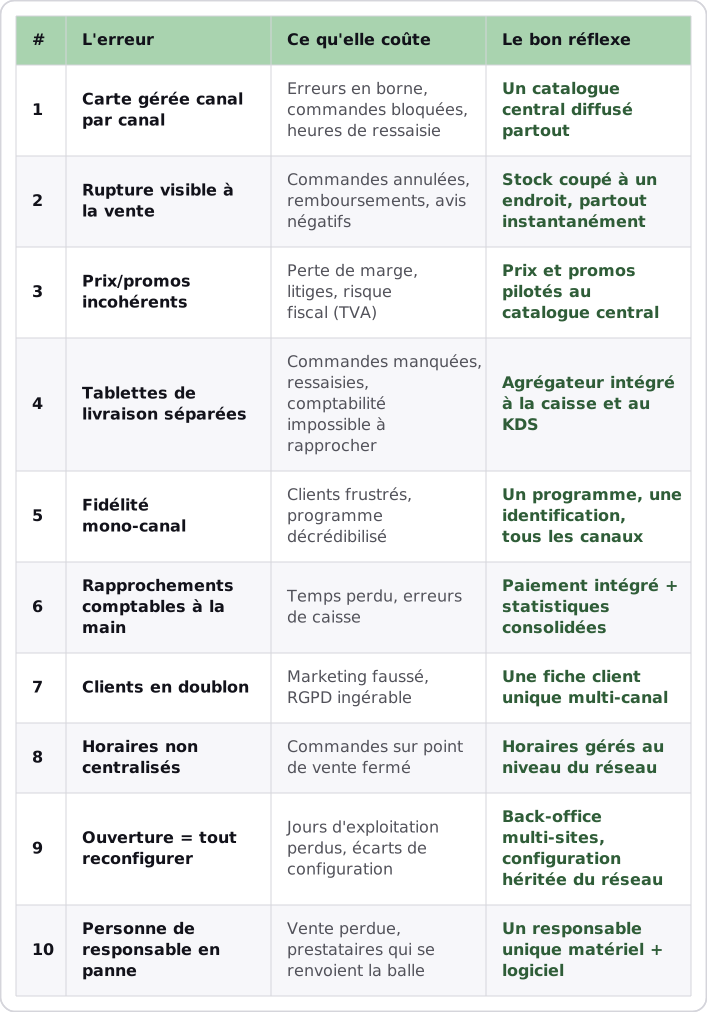
Here are the 10 mistakes we see most often in the field, among the brands that join us. For each one: what it really costs, and the right reflex to avoid it.
It is the most widespread error, and the most costly in terms of time. The menu lives in the back office of the kiosk, in that of the till, on Uber Eats, on Deliveroo and on the online ordering website. Every change has to be re-entered everywhere. The result is inevitable: one day, an update fails to propagate. A product appears on the kiosk even though it has been removed from the menu. An order gets stuck at the till right in the middle of service. And each provider passes the buck to the other.
You change a product, you forget to publish to a channel, a customer goes to a kiosk, the system throws an error. In the middle of the rush, with a queue of customers waiting, it's the whole restaurant that pays the price and your turnover that suffers.
The right reflex: one catalogue, published once, automatically distributed across all channels: kiosk, till, online ordering, delivery platforms. If your menu needs to be modified in more than one place, your architecture has a problem.
The item is out of stock in the kitchen, but it can still be ordered at the kiosk, on the app or via delivery aggregators. The customer pays, the kitchen discovers the shortage, the order is cancelled and then refunded. On the platforms, it ends up as a negative review that you will keep for a long time.
The right reflex: Stockouts happen in a single place and instantly disappear from all sales channels. It is a simple test to put any provider through: «if I cut off a product right now, how long does it take to disappear from my kiosk, my till and Uber Eats?» If the answer contains the word «re-entry», move along.
A promotion modified at the till does not sync to the kiosk. A price changed on the website is not reflected across the aggregators. The customer therefore pays two different prices for the same product, depending on where they order. At best, you lose margin. At worst, it is a dispute. And the day a VAT rate changes, the desynchronisation becomes a billing error, and therefore a tax risk.
The right reflex: Prices, promotions and VAT rates are managed in the central catalogue and cascaded to all channels without re-entry. Promotions drive sales when they are everywhere at the same time. This is also what makes a national campaign manageable across a network.
You know that shelf: the Uber Eats tablet, the Deliveroo tablet, each one chiming away in its own corner. And someone in the kitchen manually re-entering the orders into the till. That is the daily reality for thousands of restaurants, and it's a double whammy. On the one hand, orders accepted on the platform but never sent through to the kitchen: the customer is delivered late, or not delivered at all. On the other hand, end-of-day accounts that are impossible to reconcile.
The right reflex: a delivery aggregator that centralises Uber Eats, Deliveroo and your direct orders into your till and kitchen display system (KDS). Result: zero extra tablets, zero re-entering of data, and all sales going to the same place.
Customers collect points at the till, but the kiosk doesn’t recognise them. Or the app shows a reward that the till rejects. A loyalty scheme that doesn’t work everywhere is worse than no loyalty scheme at all: it makes promises and then disappoints. And it’s your team that has to deal with the frustration at the counter.
The right reflex: One programme, one identification, recognised on all channels: kiosk, till, online ordering. The phone number works very well: no card, no mandatory app. This is also what builds your true customer base, the one that platforms will never give back to you.
Transactions from the kiosk come in from one side, those from the till from another, and those from delivery from a third. And someone spends the end of the month doing reconciliations in a spreadsheet. The result: wasted time, till discrepancies, and financial visibility that is always a week behind.
The right reflex: integrated payment within sales channels (the card machine linked to the terminal and the till, not just sitting next to them) and consolidated sales statistics. What you take in must be viewable in the same place as what you sell.
A customer database in the loyalty tool, another in online ordering, a third with the CRM provider: the same customer exists three times, with different histories. Your marketing campaigns miss their mark, your footfall statistics are wrong, and the day they exercise their GDPR rights, you have to track them down everywhere.
The right reflex: a unique customer ID shared across all channels. One customer = one record = one history, no matter how they order.
Bank holiday, exceptional closure, reduced service: the hours are updated at the till... but not on the online ordering site or with the platforms. Orders come in while the point of sale is closed. Customers refunded, negative reviews, and a team that discovers the problem the next morning.
The right reflex: schedules managed once, at the network level, applied everywhere. It's a detail. Right up until the first Whit Monday when they aren't.
This is the most obvious mistake when a network accelerates. Each opening requires re-configuring the terminal with one provider, the till with another, loyalty with a third, and the platforms with a fourth. Every time: the risk of a configuration discrepancy, and days of lost operation. A network opening ten sites a year cannot afford ten bespoke projects.
The right reflex: a single multi-site back-office, where a new sales outlet inherits the network's configuration: menu, pricing, loyalty, channels. Opening becomes a formality, not a project.
This is the ultimate consequence of the pile-up, and the one that hurts the most. A terminal breaks down on a Saturday lunchtime. Four service providers pass the buck: «it's the software», «it's the hardware», «it's the integration». Meanwhile, the sale is lost, and nobody owes you a thing.
This is the ultimate consequence of the pile-up, and the one that hurts the most. A terminal breaks down on a Saturday lunchtime. Four service providers pass the buck: «it's the software», «it's the hardware», «it's the integration». Meanwhile, the sale is lost, and nobody owes you a thing.
Out of these 10 mistakes, there are surely one or two that resonate more than the others. Every retailer has its blind spots. The easiest way is to talk about it 20 minutes Together. We take a look at where you're getting stuck. If one of our deployment experts can genuinely help you, we'll tell you. If not, we'll tell you that too.
– The Author

Vifon is the co-founder and president of Belorder, a platform specialising in the digitalisation of restaurant networks. For over six years, he has been assisting brands in France and internationally in deploying omnichannel solutions: order terminals, click & collect, table ordering, payment, and multi-site management tools. Through his articles, he shares best practices and feedback from hundreds of on-site deployments.
Most multi-site management problems in the restaurant industry do not come from the equipment, nor from the...
You can sell well beyond the four walls of your restaurant, provided you choose the right channels and start with the right format.
Most restaurant chains lose operating days with every opening – almost never due to equipment, but to an overlooked prerequisite or a never-written process.
Installing a terminal is not just about placing a screen at the entrance. Calculate your budget and the price of your ordering terminals, and learn the 3 best practices of successful restaurant chains for scaling.