
Most restaurant chains lose operating days with every opening – almost never due to equipment, but to a forgotten prerequisite or an unwritten process.
CEO · Belorder
When you're already managing several establishments, opening the next one is no longer an adventure: it's an operation to be repeated cleanly. And any approximation is costly on a large scale.
Your concept is validated, your menu exists, your teams know the operations. The real question is no longer «how to open a restaurant?», but «how to integrate this new point of sale into my network without complicating its operation?». This is a problem of Systems, no motivation: at 5 restaurants, it's a management challenge; at 20, without processes, it's ten times the same mistakes.
At Belorder, we have been supporting dozens of fast-food chains for over 4 years in the deployment of their digital solutions, From the single point of sale to the large network — with franchises and multi-site brands as the main playground. After more than 1,000 assisted openings, here is the method that allows you to open faster, with fewer errors and more control.
The larger a network grows, the more standardisation ceases to be a convenience and becomes a prerequisite for profitability. In the fast-food sector, net margins often hover between 5 and 10 %: a botched opening, prices not correctly applied at a site, or poorly managed stock can eat into these margin points very quickly.
The chains that roll out smoothly have all formalised a written standard, whereas others still transmit their habits orally. This standard allows them to:
The format that worked on your last restaurants must become a Standard documented, not a recipe in one person's head.
It's this repeatability that distinguishes a network that scales from a network that replays the same problems at each site.
An opening specification is the single document sent to each new site, which centralises everything that would otherwise have to be reinvented for each opening. The most successful networks systematically have this. It brings together:
Without this document, each opening starts from scratch. With it, even a network of two or three restaurants saves considerable time at the next opening. The right move isn't to wait for ten sites before writing it: it's to establish it now, even if you plan to add to it with each deployment.
Download our brief template — The ready-to-use template for outlining each new site (plans, equipment, prerequisites, tests).
A successful opening isn't prepared a fortnight beforehand. The deployment is played out over two layers an upstream phase (commercial, onboarding, configuration, channels) to define, followed by the installation itself, concentrated in the final days.
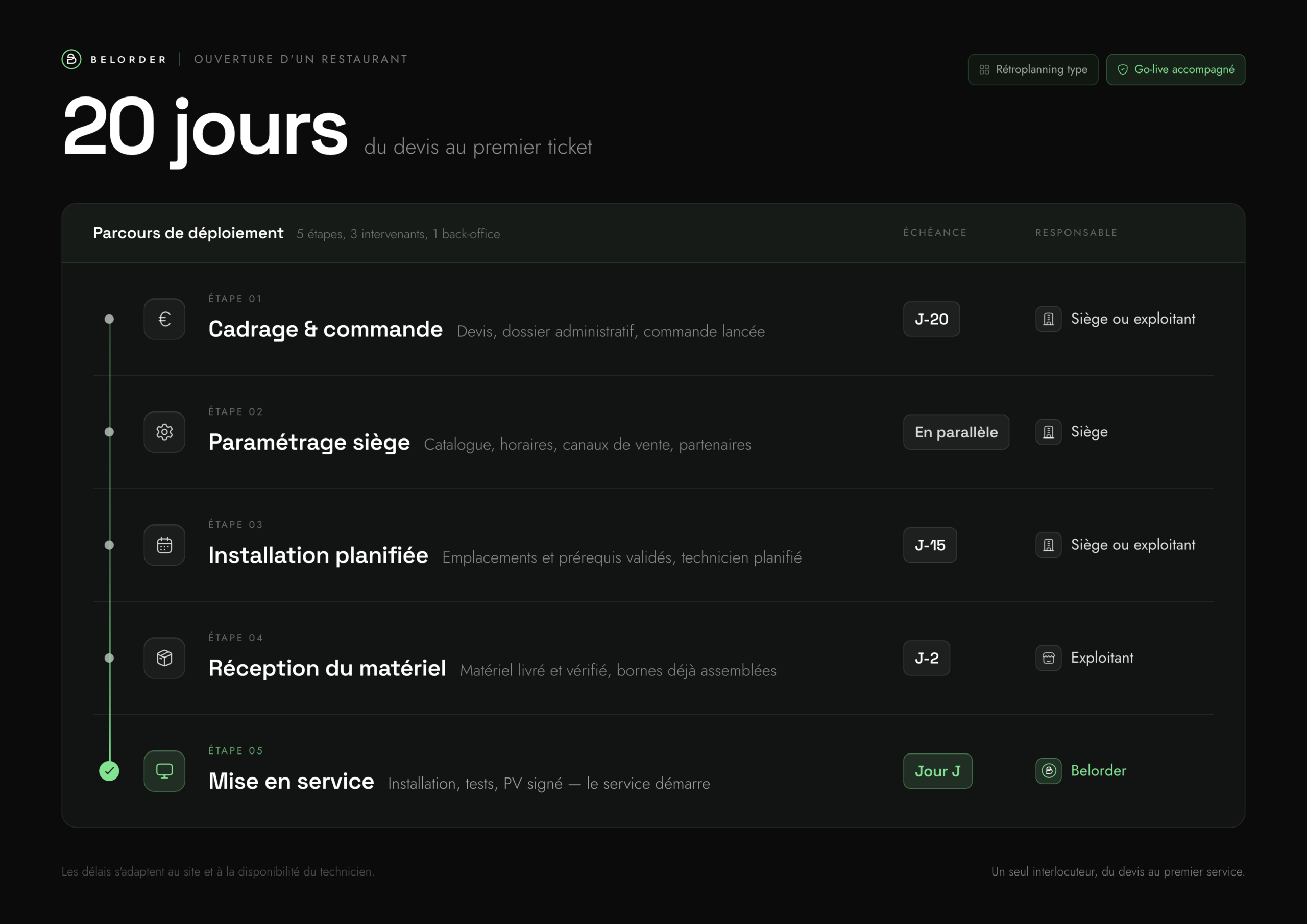
The most often underestimated point: The activation of the delivery channels and synchronisation via the UberEats/Deliveroo aggregators are prepared in advance, not on the day itself.
The difficulties of an opening rarely come from the material itself. In the vast majority of cases, they stem from a forgotten prerequisite. Before confirming the installation date, four conditions must be met:
Most of our installations can be carried out remotely – you set up the terminal, powered on and connected, and our technical team takes over for configuration and testing.
In most openings, two terminals form the right starting point. One quickly creates anticipation at its peak; two absorb the flow while preserving the customer experience. But the right number depends most on your peak hour throughput.
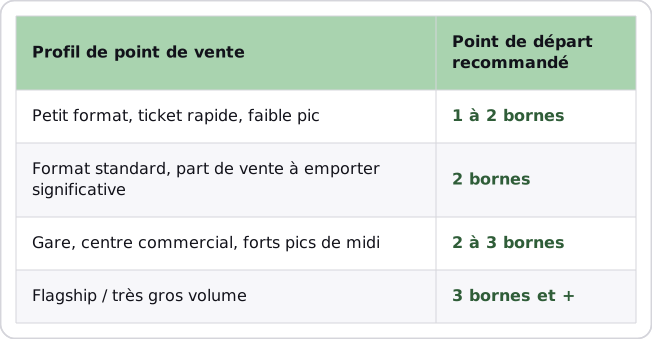
Beyond the number, it's the role of the terminal that matters: when properly configured, it takes charge of upsells and loyalty with each order — a lever that explains the +15 to 30 % average basket prices observed on the market of restoration.
The point of sale (POS) is the backbone of a network. Each establishment must have it the same software, with the same integrations, from a centralised catalogue and adaptable price management by site. A point of sale in a town centre, train station or shopping centre does not have the same constraints: the infrastructure must allow for these adaptations without increasing operational costs, with real-time reporting to head office.
However, the customer experience must remain consistent everywhere. The goal is not to activate all channels on the first day, but to Clearly define everyone's role :
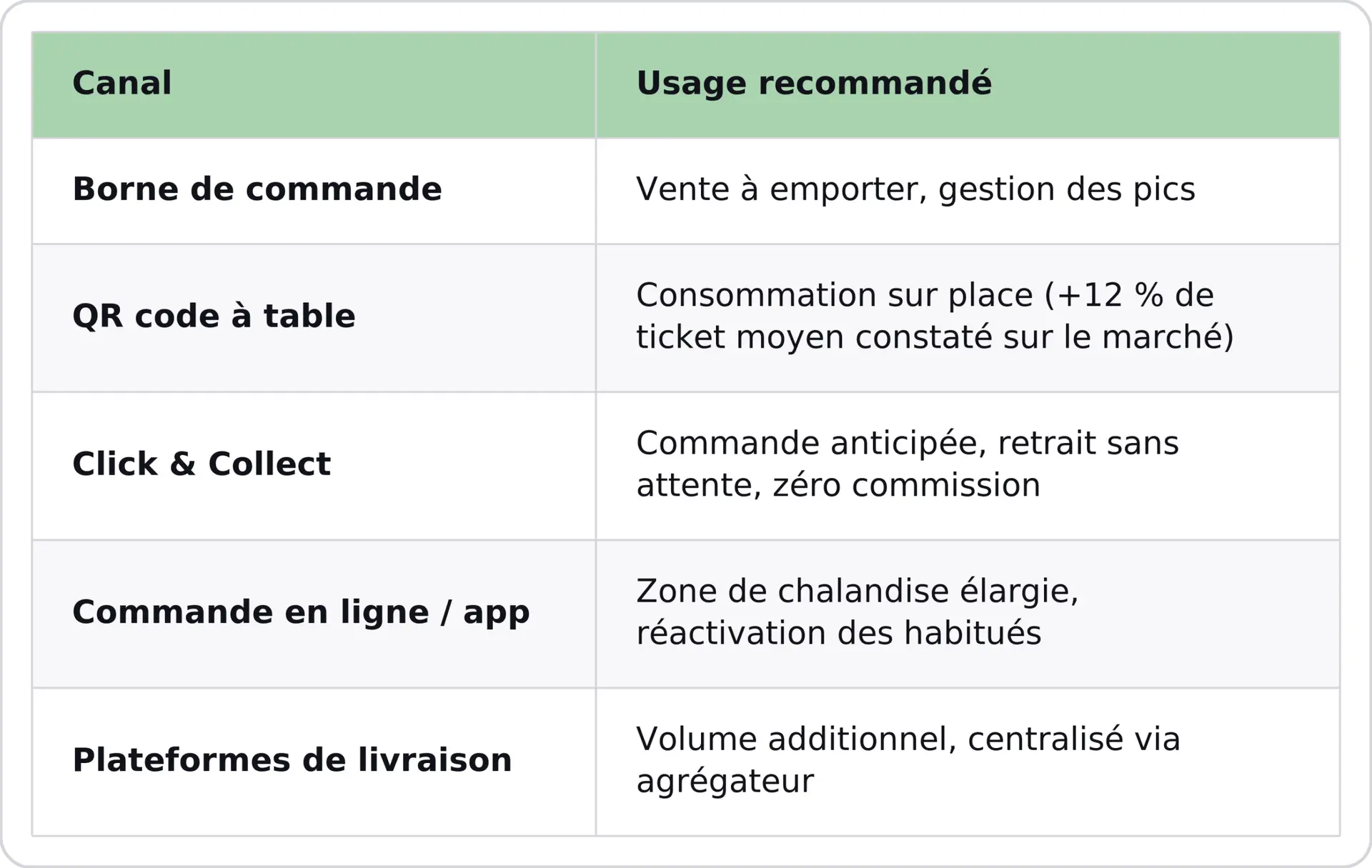
Mix uses, — boundary and QR code for the same route, — creates confusion for both customers and teams.
A command must Never to be re-entered manually. Each restaurant must have a kitchen display system (KDS) automatically synchronised with the till, which prioritises and paces production from station to station. The same logic applies to platforms: a Aggregator Get UberEats and Deliveroo orders straight to the kitchen, with no double entry or transcription errors. The objective is simple: fewer mistakes, a smoother service, and reliable data that goes straight to head office without human intervention.
This is one of the most overlooked elements of an opening. People think about the checkouts and kitchen screens, but rarely about how the customer will be notified. Yet, this choice is an integral part of the customer journey, and it must be the same across the whole network.
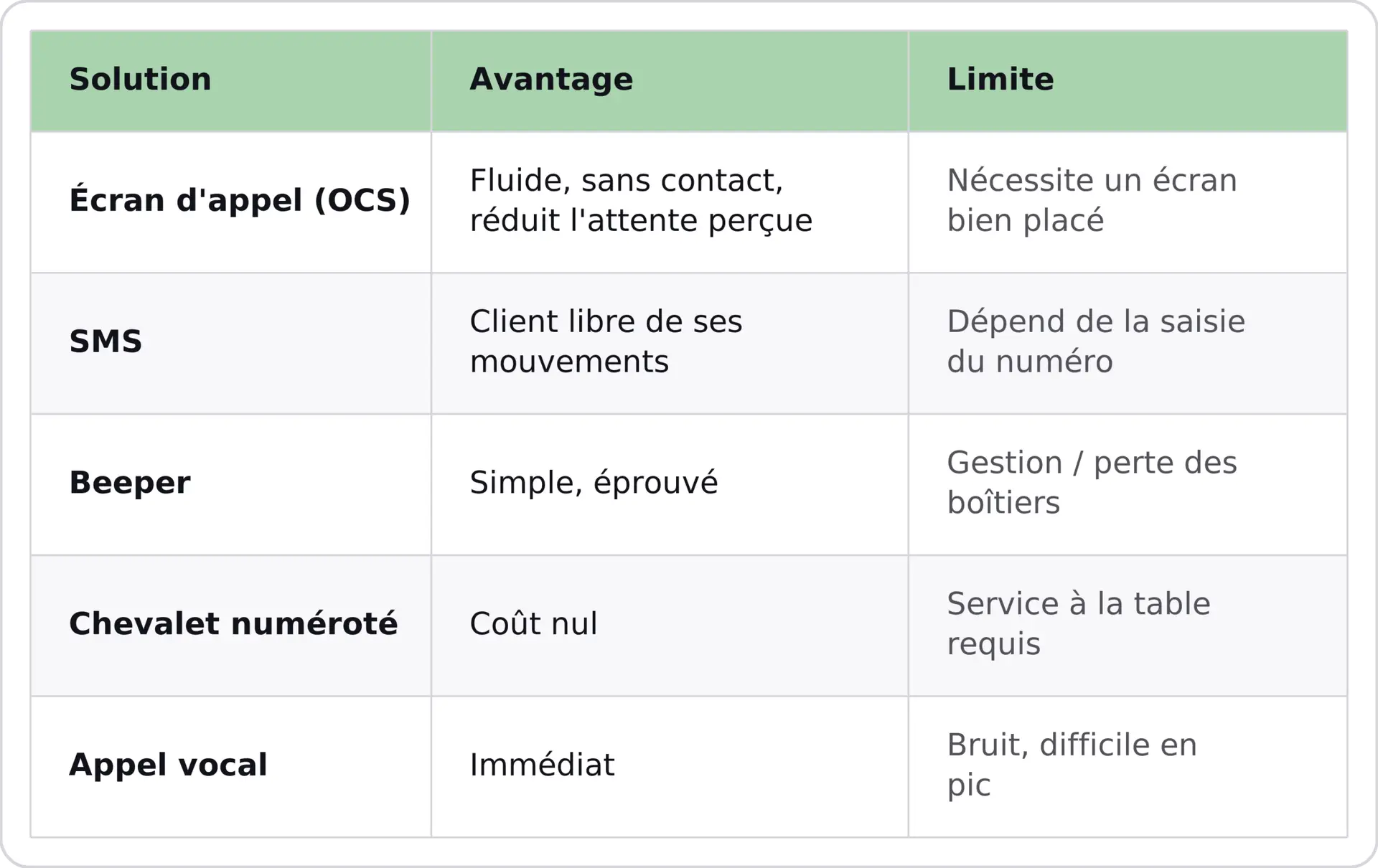
The most seamless networked solution remains the call screen synched with the KDS and the till: ready numbers display automatically, the counter flows more smoothly. The important thing isn't the tool itself, but applying the same logic everywhere.
The opening doesn't just depend on the work and the equipment. In parallel with the installation, headquarters prepares the point of sale's configuration:
An incomplete configuration almost always results in delays or errors from the outset.
Are you preparing an opening? Receive a free audit of your deployment process in 20 minutes.
After more than [100] accompanied openings, the same errors keep recurring systematically.
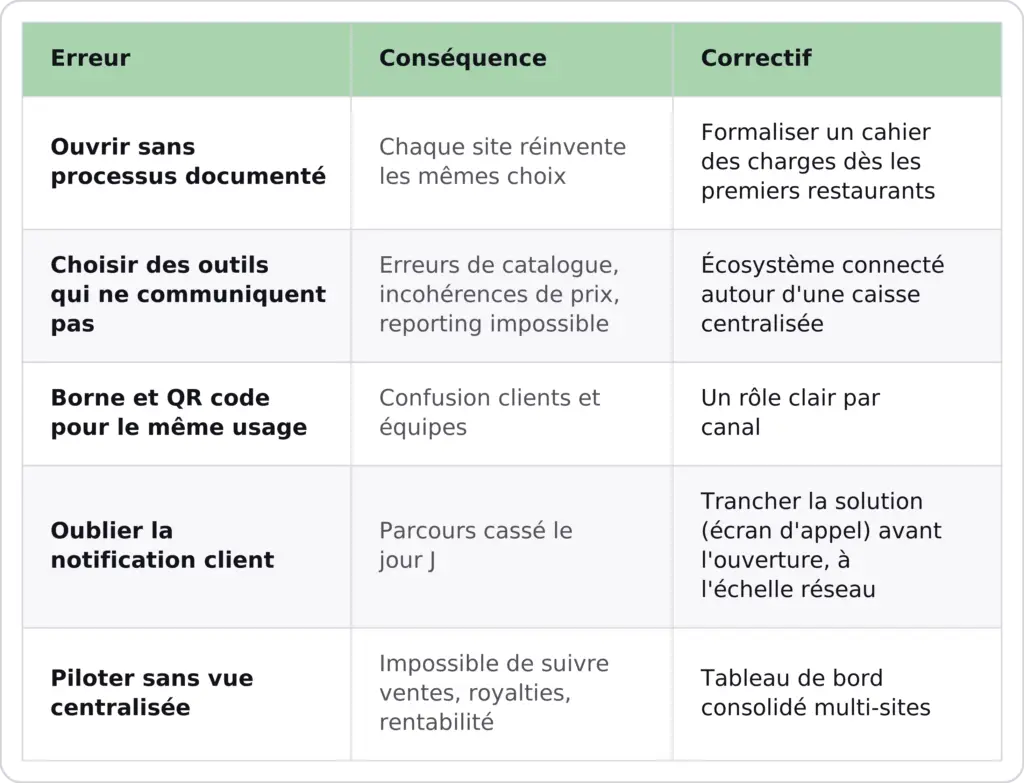
The ideal operation always follows the same logic:
This operational continuity is often what distinguishes a network capable of growing smoothly from one that fixes the same problems with every opening. It's also what secures your regulars — who often weigh up to 65 % of turnover observed on the market — from one site to another.
The fundamentals are exactly the same: forecasting technical installations, choosing a connected till system, standardising customer journeys, documenting procedures, and centralising data. Only the level of formalisation changes. Laying these foundations today will prevent us from having to rebuild everything across five sites.
From signature to go-live, Belorder handles the entire digital aspect of your openings, friction-free:
Connected till, terminals, KDS, call screen, Click & Collect, table ordering, payment (Belorder Pay®, meal vouchers, country-specific payment methods) and consolidated reporting — all managed from A single back-office, with a Dedicated Account Manager which monitors your deployment and performance over time. Each installation is validated by a signed minutes, and support remains contactable Monday to Friday. This is what allows brands like Pokawa, Black & White Burger, Enjoy Tacos… to roll out new sites without having to start from scratch, and to reduce the time it takes to get them up and running.
Book a demo: See how your next three branch openings can be managed from a single back-office.
These are the questions I'm asked most often:
Outline the deployment at D-20: commercial phase, onboarding, head office setup and channel activation. The order is delivered within 12 working days, installation is scheduled at least 15 working days in advance, then commissioning focuses on the final days (D-2 to D).
This is the single document sent with every new opening. It centralises plans, equipment locations, electrical requirements, till systems, integrations, kitchen screens and installation procedures, so that each site doesn't have to start from scratch.
Four conditions: equipment received and verified, power supply operational, internet connection stable, and number of outlets compliant with prerequisites.
If you’ve never installed payment terminals before, start with two to handle peak demand. The right number depends mainly on the volume of business at peak times and the proportion of takeaway sales.
No, they complement each other: the kiosk is for takeaway orders, and the QR code is for eating in. The pitfall is using them for the same purpose.
Via a kitchen display system (KDS) automatically synchronised with the till, and an aggregator for delivery orders – to eliminate any manual re-entry and ensure reliable tracking.
Yes, for certain set-ups: you set up the equipment and switch it on, and the technical team then takes over remotely to configure it and carry out tests.
Once you have five or six outlets, centralising sales, catalogues and performance data becomes a major operational challenge — but laying the groundwork when you have just two or three sites saves valuable time.
– The Author

Vifon is the co-founder and president of Belorder, a platform specialising in the digitalisation of restaurant networks. For over six years, he has been assisting brands in France and internationally in deploying omnichannel solutions: order terminals, click & collect, table ordering, payment, and multi-site management tools. Through his articles, he shares best practices and feedback from hundreds of on-site deployments.
Most multi-site management problems in the restaurant industry do not come from the equipment, nor from the...
You can sell well beyond the four walls of your restaurant, provided you choose the right channels and start with the right format.
Most restaurant chains lose operating days with every opening – almost never due to equipment, but to an overlooked prerequisite or a never-written process.
Installing a terminal is not just about placing a screen at the entrance. Calculate your budget and the price of your ordering terminals, and learn the 3 best practices of successful restaurant chains for scaling.