
CEO · Belorder
Installing a terminal isn't just about putting a screen by the entrance.
What makes the difference is that it talks to the rest: your till, your kitchen, your catalogues, your delivery platforms.
Otherwise, you're juggling four or five providers who don't synchronise, and you're the one left to pick up the pieces. The real question, therefore, isn't «how much does a terminal cost?», but «how much does a reliable system cost that works, from the customer's first click all the way to the plate?».
A cheaper terminal to purchase can quickly become more expensive: bugs, abandoned orders, hidden fees. In this article, we look at everything:
Before comparing screens and prices, a simple question: what does your restaurant really need? The choice depends on three criteria, in this order:
The budget isn't just about the purchase price; it depends primarily on your growth stage: a first point of sale, ten openings in a year, or the standardisation of a network of franchisees. As soon as you're thinking multi-site, count everything — number of terminals per point of sale, installation, subscription, support. The real question isn't «how much does the screen cost?», but «what's the budget for a terminal installed, configured, connected, and ready to take payments?».
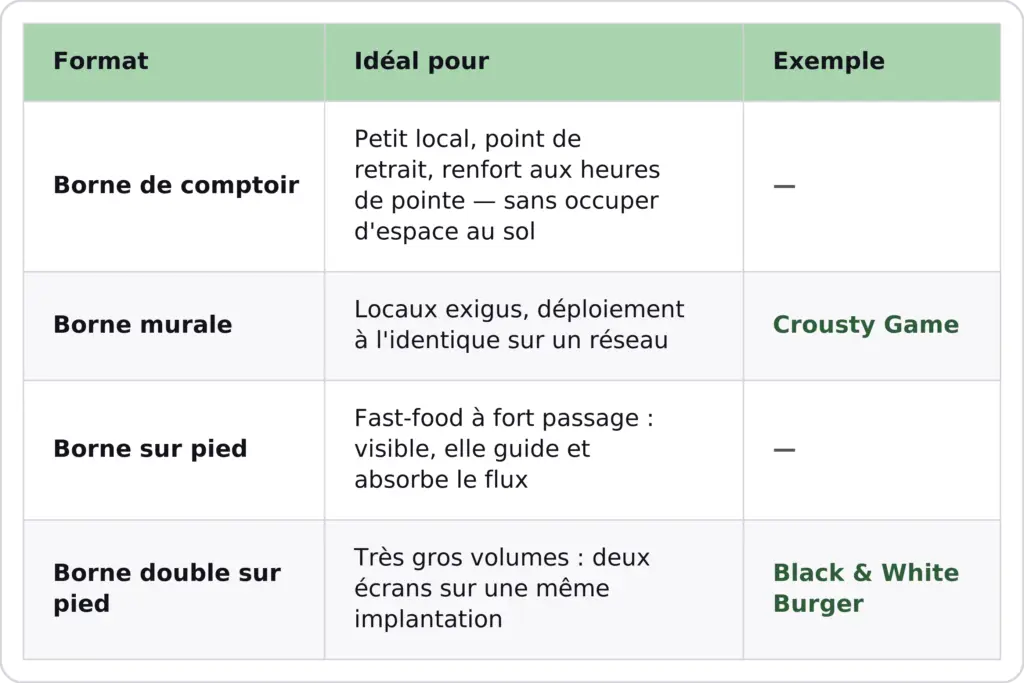
Not all terminals tell the same story. In a high-volume fast-food restaurant, the terminal needs to be visible, guide customers quickly, and process payments smoothly. Black & White Burger opted for large, double, freestanding terminals, embracing them as a symbol of modernity as well as a ordering channel. In a more relaxed setting, however, the terminal should be discreet to maintain consistency with the atmosphere. Define what you’re looking for: handling peak hour rushes, increasing the average order value with suggestions, or a sleek terminal dedicated to collection and Click & Collect. Your terminal is part of your brand image, not just your logistics.
The experience is also played out on what the terminal can do: an interface to your colours (visuals, typography, user journey), highlighting the Allergens and food filters, a integrated marketing in the customer journey (Banners, targeted pop-ups, configurable promotions up to «buy one get one free») broadcast at the precise moment the customer decides, and a Built-in loyalty The customer identifies themselves with their phone number, accumulates points, uses their rewards, and finds their favourites for recommendations in seconds. This is what transforms the kiosk into a true digital salesperson, capable of promoting your high-margin products – not just a data entry screen.
The space often dictates the format above all else. A large, busy fast-food restaurant? Freestanding double terminals, clearly visible, that handle high volume – as with Black & White Burger. A small premises? A wall-mounted terminal, compact, adding a channel without clutter – this is Crusty Game’s choice. A chain with many outlets will opt for wall-mounted terminals that are easy to deploy and standardise; a more traditional restaurant will prefer a discreet and elegant format, avoiding a fast-food impression. Your space determines the format, location, number of terminals, and what is connected to them: payment, printer, screen.
As a benchmark, here are the price ranges observed on the market for the equipment alone:
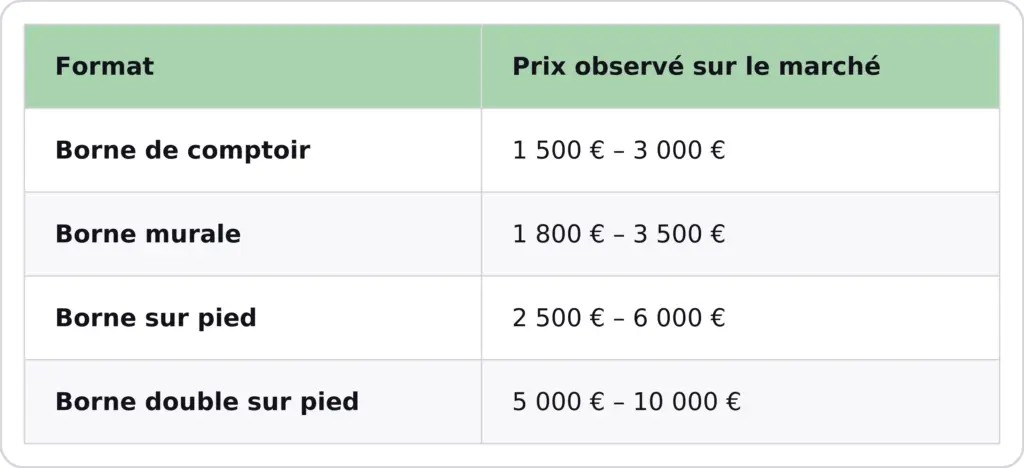
At Belorder, the logic is straightforward: as software publishers first and foremost, we don't make our profit on hardware. We sell it at the fairest price, generally at the lower end of the price ranges, because the value lies in the software that runs the terminal and enables you to sell, not in the price of the screen. The exact figure depends on your configuration: the most reliable approach is to request a quote for your project. All formats also accept the payment 100 % digital (Tap to Pay, without POS terminal) and the digital ticket (without printer), two options that further reduce the cost.
At the same format, the price changes according to: the Screen size and performance, is’Cladding (customisation in your colours), the peripherals (Payment terminal, receipt printer), the number of terminals ordered (degressivity), the Installation complexity, and the Software features (suggestions, loyalty, multilingual, multi-site management).
The price of a charging station is never just the hardware. To get a clear picture, it breaks down into four posts :
Beyond these four positions, also consider the less visible costs: the Menu setup and there Team formation initially, then the maintenance and the’Support customers during peak periods – all points where a partner who manages everything end-to-end saves you time.
A cost that is underestimated is that of a terminal that doesn't communicate with the rest of your tools: duplicate entries, stock discrepancies, kitchen errors. A well-integrated terminal connects to your till software, synchronises products and availability in real time, Automatically send orders to the kitchen (KDS), and connects to your loyalty scheme as you Online ordering and your mobile app. Result: a single card, a single source of truth, and no heavy operational changes for your teams. This is precisely what separates the purchase of a screen from the installation of a system.
A terminal is not an expense, it's an investment. It pays off in several ways: a higher average basket, better-absorbed flow, less waiting, fewer errors, and time saved for the teams.
Let's take a restaurant that makes 150 orders per day with a Average basket value of €15, where 6 out of 10 orders go through the terminal once installed (a proportion commonly achieved in the fast-food sector when the terminals are well positioned). Here are three scenarios, ranging from the most conservative to the most favourable:
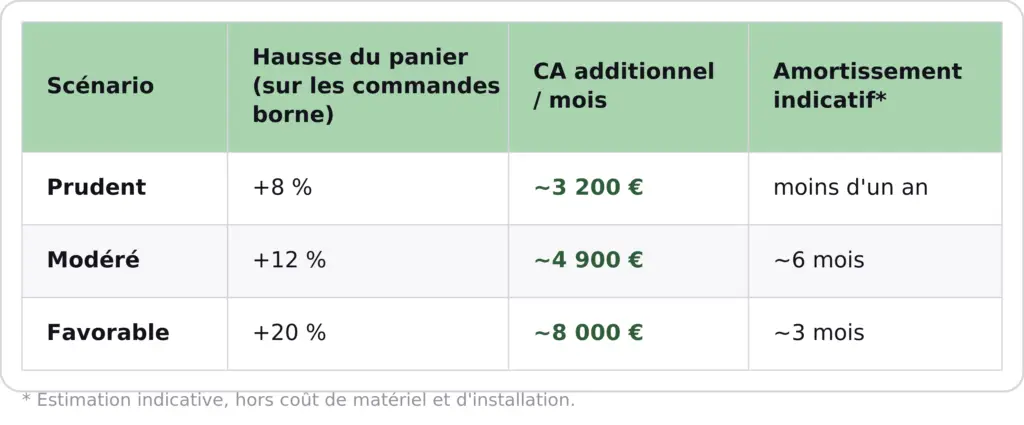
The correct calculation is made with your own figures: we do it with you in 25 minutes, using your actual volumes by booking an appointment with our network deployment expert.
The three levers of profitability
What the terminal board changes (observed on the market). Average basket increases of +10 to +20 % are commonly observed thanks to auto-suggestions — up to +30 % in the most favourable configurations. Added to this is a Reduced waiting during peak hours and Clearly fewer order errors, since it is the customer themselves who composes and validates their order. Your results will depend on your map, your suggestions, and the location of the terminals – hence the importance of setup support.
Paying outright isn't always the best choice – especially when opening a new venture, or when you're testing a concept. Renting and leasing allow you to get started without tying up your cash flow. This is useful when your launch budget is tight, when you're opening several sites in quick succession, or when you want to try something out before committing. For a franchise, it's also a relief for franchisees, who are already financing the renovations, kitchen equipment and staff.
The refereeing is simple:
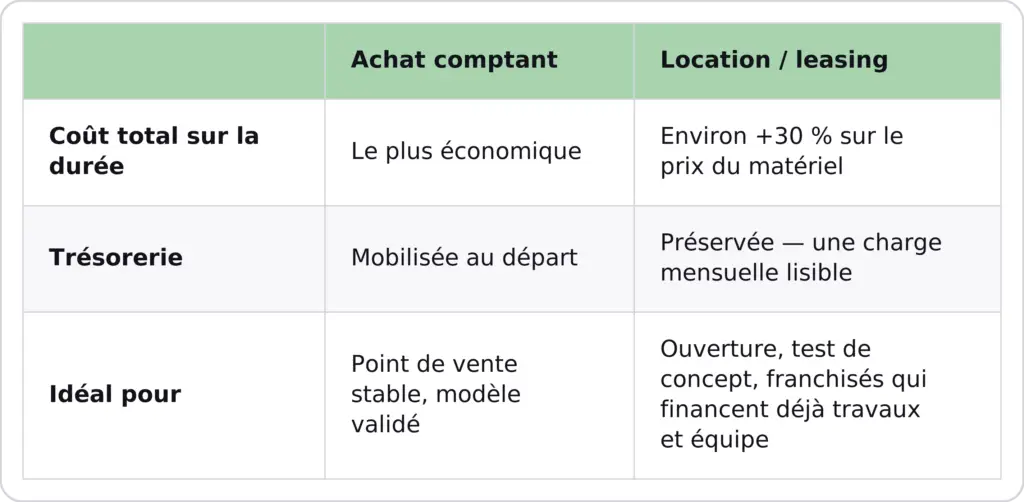
For a growing network, the best reflex is often to Mixer Rent for the initial tests, buy once the model is validated.
A cheap charging station is a nice surprise on a quote. The problem isn't the price – it's everything that's missing afterwards.
A terminal purchased online, with no one behind it, is just hardware delivered and then nothing more.
And even when the hardware works, buying it «bare» online deprives you of the essential: support. Working with a 360-degree partner like Belorder isn't just about receiving a charging point – it's about being supported throughout the Software configuration and, above all, on the suggestion design This is the work that truly increases the average basket size. It is this work that allows the basket increases observed on the market to be achieved. A poorly configured point of sale system, without upsell logic designed for your menu, will never deliver this return on investment.
Two quotes are never compared line by line. A provider may show a Cheap to buy but expensive to subscribe, another the opposite — and a third a near-zero subscription that hides unreachable support and software that doesn't sell. The only comparison that matters concerns two digits the total cost over 3 to 4 years (equipment + subscription + payment) and the turnover generated by the terminal during the same period.
This reflex changes everything. Saving £50 a month on subscriptions has no point if, due to a lack of well-thought-out suggestions, the software makes you lose £300 in lost basket value — or if, on the day of a breakdown, no one answers.
Hardware is a cost; software is an investment. The terminal simply takes the order. Which makes win money – sales suggestions, integrated marketing, loyalty, upgrades – lives in the software, and therefore in the subscription. Trying to minimise the subscription is often cutting into the only profitable line item.
The right questions to ask each service provider:
Depending on the type of provider, the answers differ significantly:
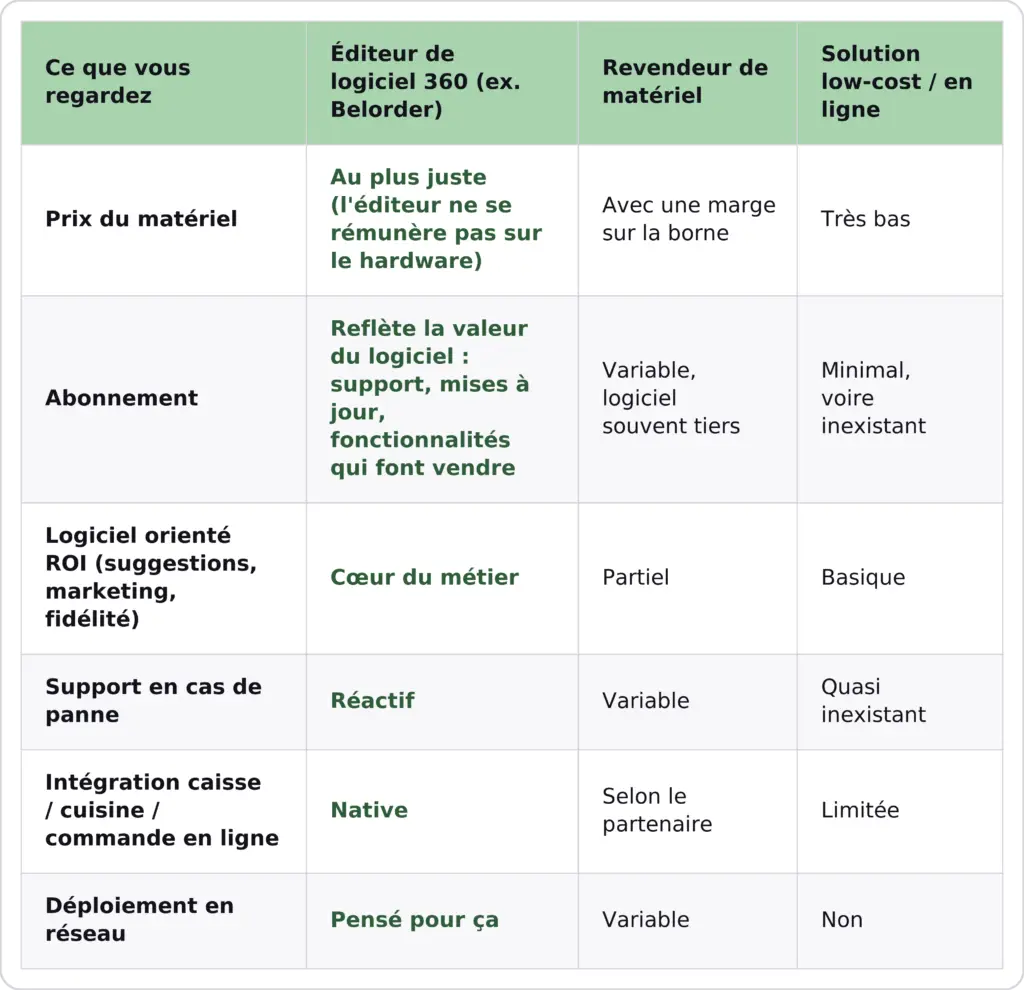
The logic of a editor as Belorder is assumed: the The material is sold at the fairest price. — that's not where we earn our living — and The subscription reflects the value of the software, the one that increases your basket size, runs smoothly and evolves over time. Our interests are therefore aligned with yours: that your charger report, not just that it's expensive to buy. It's also what makes a Network easier to equip — inexpensive equipment multiplied by your sales points, that's a much lighter equipment budget.
Let's be clear: Belorder isn't the only 360° publisher on the market — and that's precisely why the five questions above are relevant all the service providers, ourselves included. Ask each of them, demand quantifiable answers about your actual volume, and compare the total cost over 3-4 years and the revenue generated. This is a comparison we are happy to support.
Furnishing a restaurant is a purchase. Furnishing a network is an investment. Deployment project — and four questions arise that do not exist in a single-site configuration:
Who pays? In most networks, it's the Franchisee who invests within its boundaries, as it invests in its kitchen — the franchisor, for its part, references the solution and negotiates the Group conditions (cost of equipment, subscription, deployment) that each point of sale benefits from. Leasing is often favoured by franchisees, who are already financing renovations and staff: it transforms the terminal into a manageable monthly expense rather than an upfront investment.
How to deploy quickly and identically? A network cannot afford 40 artisanal installations. What matters is one Standard format (the wall-mounted charger is often chosen for this), a centralised configuration replicated at each opening, and a partner capable of installing at your pace. This is where the cost of the hardware counts double: a difference of a few hundred euros per terminal, multiplied by your points of sale and the number of terminals per site, changes the network equipment budget.
Who is piloting the boat? On a network, the menu cannot live in 40 different back-offices. You need a Menu governance : a nationally driven menu (products, prices, visuals, sales suggestions), with controlled local variations. This is what guarantees that the upsell strategy — the one that increases the average basket value — is applied everywhere, not just in your best points of sale.
How to follow the results? A network director needs a Consolidated reporting average basket size per site, proportion of orders placed at the terminal, performance of suggestions — to compare points of sale and share best practices. Without this overview, it's impossible to really know if the estate is «profitable».
All-in, expect to pay between €2,000 and €2,500 for the installation and commissioning of your first terminal — and up to €10,000 for large, freestanding double-screen models. On top of this, there is a software subscription (€40 to €200 per month per terminal) and the cost of each transaction. The 100 % digital payment system (Tap to Pay, digital receipt) also removes the payment terminal and printer from the hardware budget, and the cost per terminal falls as soon as you deploy several of them.
Beyond the hardware: menu installation and setup, team training, software subscription, maintenance and updates, payment commissions, and indirect costs (rearrangement of restaurant workflow, customer support during peak hours). A cheap but unreliable terminal adds support costs and lost orders.
Buying works out cheaper in the long run but ties up more cash flow; renting (expect to pay around 30% more than the purchase price) spreads the cost and provides a safety net for a launch or trial. For a growing network, it is common to rent initially to test the equipment and then purchase it once the model has been validated.
A good charging point integrates with main point-of-sale software on the market It synchronises products and availability in real-time, sends orders to the kitchen, and links to your loyalty scheme as well as your online order. The aim is to avoid any double entry: the terminal becomes another channel on the same system, not an isolated tool. Before signing, ask for the list of actually available till integrations — it's a disqualifying factor.
With a partner who manages the project from start to finish, no: the terminal is delivered, installed, connected, then configured (menu, photos, options) and your teams are trained on how to use it. Complexity – and cost – increases especially if you multiply uncoordinated service providers or if you buy hardware «bare» without support.
Yes, mainly through the average basket value: the terminal systematically offers add-ons, desserts and meal deals, whereas an employee wouldn't have the time during the peak rush. Increases in basket value of the order of +10 to +20 % are commonly observed in the market for orders placed at the terminal — up to +30 % in the most favourable cases. Added to this are improved capacity to handle peak-time volumes and a reduction in errors. The key requirement: well-thought-out sales suggestions for your card — this is where our support makes all the difference.
In the vast majority of fast-food restaurants, yes — and quickly: the process is simple, visual, available in several languages, and an order can be placed in 1 to 2 minutes. Adoption will depend, however, on your clientele and the placement of the terminals: an older, regular customer base will adopt more gradually than a rushed, urban flow. The two levers that make the difference: placing the terminals well and perfecting the interface.
Most often within less than a year, and within a few months in busy restaurants. Example: based on 150 orders per day with an average basket value of €15, if 6 out of every 10 orders are placed via the self-service terminal, the additional turnover ranges from around €3,200 per month (conservative scenario, +8 % per basket) to €8,000 per month (favourable scenario, +20 %) — the margin from which more than covers the subscription fee and pays for the equipment. The correct calculation is based on the margin, using your own figures.
At Belorder, there is no monthly subscription for payment processing: you pay a commission on each transaction, with conditions adjusted to your volume, and the interchange fee (the part paid back to banks, identical regardless of the provider) is recharged at cost price. To compare two payment offers, never compare advertised rates: ask for a numerical simulation based on your actual annual volume.
In most networks, the franchisee invests in their charging stations – much like their kitchen – while the franchisor references the solution and negotiates group conditions (equipment, subscriptions, deployment) that each outlet benefits from. Leasing is frequently used by franchisees to transform investment into a discernible monthly charge.
Above all, be wary of hardware bought «bare» online: often no RMA, no warranty, no spare parts, and no support – meaning a terminal that's out of action and lost orders at the first hiccup. And without assistance with setup and sales suggestions, the terminal won't deliver the basket-size increase that justifies the investment. Compare what the terminal costs you and what it earns you over several years, not the displayed price.
Most restaurants start with two terminals to absorb peak times; the right number depends mainly on peak hour throughput and the proportion of takeaway sales.
– The Author

Vifon is the co-founder and president of Belorder, a platform specialising in the digitalisation of restaurant networks. For over six years, he has been assisting brands in France and internationally in deploying omnichannel solutions: order terminals, click & collect, table ordering, payment, and multi-site management tools. Through his articles, he shares best practices and feedback from hundreds of on-site deployments.
Most multi-site management problems in the restaurant industry do not come from the equipment, nor from the...
You can sell well beyond the four walls of your restaurant, provided you choose the right channels and start with the right format.
Most restaurant chains lose operating days with every opening – almost never due to equipment, but to an overlooked prerequisite or a never-written process.
Installing a terminal is not just about placing a screen at the entrance. Calculate your budget and the price of your ordering terminals, and learn the 3 best practices of successful restaurant chains for scaling.